 VapeWholesaleHub
Nicotine Level Documentation Pack for Customs Brokers — North America
The price difference between two nicotine level quotes is often smaller than the cost of one failed shipment. This overview is written for buyers who would rather understand the failure modes up front than discover them after customs clearance.
What Nicotine Level Really Costs Landed
The cheapest nicotine level quote is rarely the cheapest outcome. Add freight, defect handling, delay risk and the staff time spent chasing, then compare again. The ranking often changes.
Indicative reference points for planning purposes: entry tier from USD 2.12 per unit at 500 units, mid tier at USD 0.73, and volume tier at USD 0.55 for full container quantities. These figures move with specification, packaging and freight, so treat them as a shape rather than a quote.
Positioning Nicotine Level on Your Shelf
Range decisions for nicotine level should start from shelf space, not from a supplier catalogue. Count the facings you actually have, then decide how many of them this line deserves against what it currently earns.
Logistics That Protect Margin
Consolidating nicotine level with other lines is often the biggest single saving available to a mid size importer. The unit cost does not change but the landed cost does, sometimes materially.
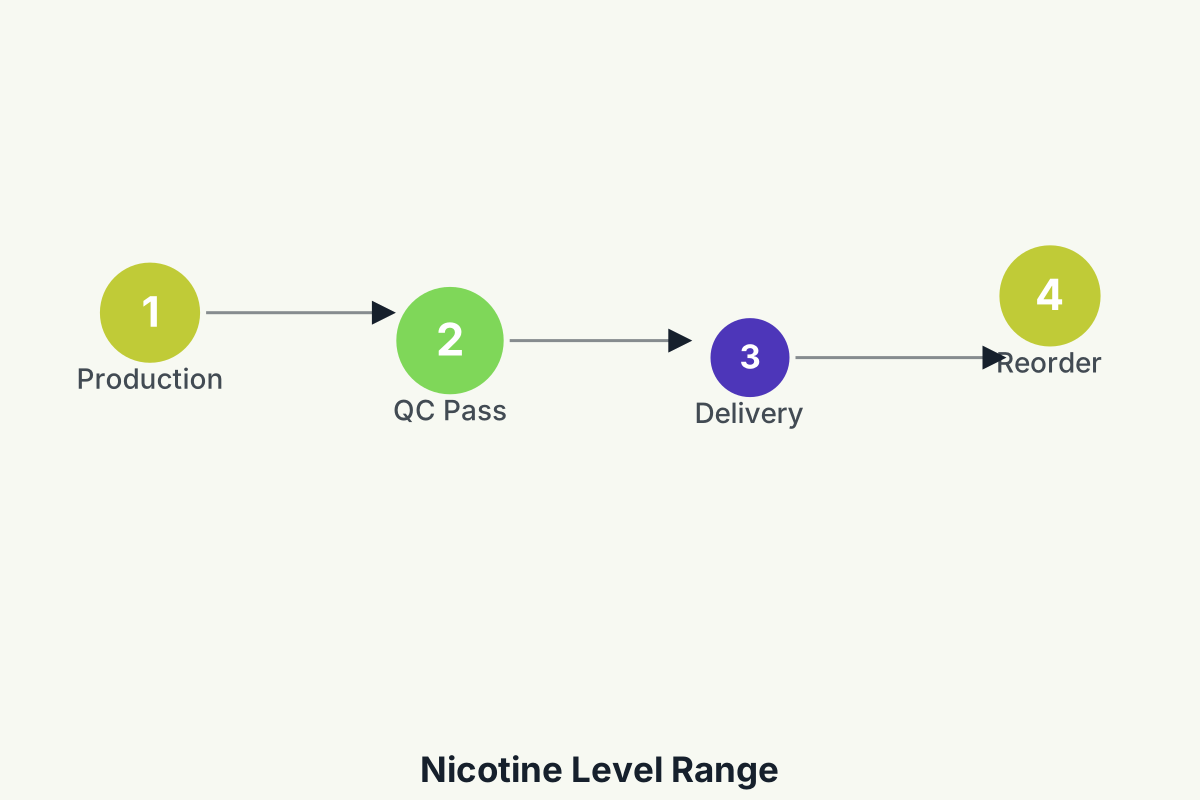
Merchandising and Listing Tips
Use your nicotine level staff training time on the two questions customers actually ask. Anything more detailed gets forgotten by the second shift.
The Specification That Matters
A written nicotine level specification should be short enough to read in a minute and precise enough to argue about. If a factory cannot confirm a number in writing, assume the number is whatever is cheapest that week.
Specification sheets are where a nicotine level deal is won or quietly lost. Two samples can look and taste the same while using different coil wire, different wicking density and different tolerances on the mouthpiece. Those details decide how the unit behaves in week three rather than minute three.
| Product category | Open system |
|---|---|
| Resistance band | 0.8 - 1.0 ohm |
| Capacity tolerance | +/- 5% |
| Puff count method | Declared by capacity |
| Master carton | 240 units |
| Carton weight | 11.4 kg |
| Shelf life | 18 months |
| Storage | 15-25 C, dry, away from direct light |
Practical Checklist
- Write the complaint threshold into the order terms.
- Plan the switch from air to sea freight before you need it.
- Agree the tolerance band in writing before approving artwork.
- Keep sealed retained samples from every production batch.
- Rotate stock by batch code rather than by delivery date.
- Model landed cost, not ex-works price, when comparing quotes.
Frequently Asked Questions
What happens if my market changes its rules?
Regulations move, and packaging or documentation sometimes has to follow. We keep approved artwork files on hand so that a required change is a reprint rather than a redesign, which keeps the cost and delay down.
Can I mix strengths in one order?
In most cases yes, as long as each strength meets the minimum run length. Mixed strength cartons are popular with retailers building their first display because they show the full ladder without over committing.
What if I only need a small first order?
That is normal and sensible. A mixed carton lets you test nicotine level in your own market before committing to a production run, and the specification you approve at that stage carries through to larger orders unchanged.
Is there support for in-store material?
Yes. Shelf talkers, counter cards and simple planogram suggestions are available for nicotine level ranges that reach a sensible volume. Most retailers find the plain strength and flavour cards do the most work.
Next Step
Start smaller than feels comfortable, measure honestly, then scale what worked. That sequence has saved more of our customers money than any negotiation tactic we could suggest.
Related Reading
- Nicotine Level Trade Credit and Account Terms — the Buying Desk
- Nicotine Level Forecasting Without Historical Data — Online Sellers
- Nicotine Level Slow Moving Stock and Remedial Actions — Container-Scale Orders
- Wholesale Nicotine Level: A Practical Buying Guide for Retailers — Multi-Warehouse Networks
- Nicotine Level Regulatory Change Monitoring — the Buying Desk
- Nicotine Level Packaging Formats That Reduce Damage Claims — Mixed Cabinets