 VapeWholesaleHub
Nicotine Level Approval Workflow From Sample to Shipment — Premium Shelf Programmes
Retailers rarely lose money on nicotine level because of price. They lose money because the first container was bought on a photograph. This page walks through what actually matters when you source nicotine level at scale, written from the buying desk rather than the marketing department.
How Nicotine Level Fits the Assortment
One useful exercise: list every nicotine level line you stock and mark the last date each one sold at full price. Anything without a recent full price sale is taking space from something that would use it better.
Before anything else, decide which customer you are buying nicotine level for. A convenience counter with limited shelf depth needs a tight range that turns quickly, while a specialist shop can carry a deeper ladder of options and educate buyers into higher ticket lines.
Modelling a Healthy Margin
When nicotine level input costs move, ask which component moved. A generic price increase hides whether you are paying for cells, packaging or simply a busy production calendar.
Margin on nicotine level is rarely lost at the till. It is lost through dead stock, returns and emergency air freight. A slightly higher landed cost with predictable lead time usually beats the cheapest quote on the spreadsheet.
Indicative reference points for planning purposes: entry tier from USD 2.17 per unit at 2000 units, mid tier at USD 1.67, and volume tier at USD 1.35 for full container quantities. These figures move with specification, packaging and freight, so treat them as a shape rather than a quote.
Merchandising and Listing Tips
Online, the listing for nicotine level should answer three questions without scrolling: what it is, how strong it is, and what it tastes like. Everything else belongs further down the page.
Keep the nicotine level range tidy. A half empty shelf reads as a dying line, and customers interpret it that way faster than any signage can correct.
Freight, Customs and Timing
Freight is the hidden half of nicotine level unit economics. A denser master carton can save more per unit than a hard negotiation on factory price, because the saving repeats on every reorder rather than once.
Freight is the hidden half of nicotine level unit economics. A denser master carton can save more per unit than a hard negotiation on factory price, because the saving repeats on every reorder rather than once.
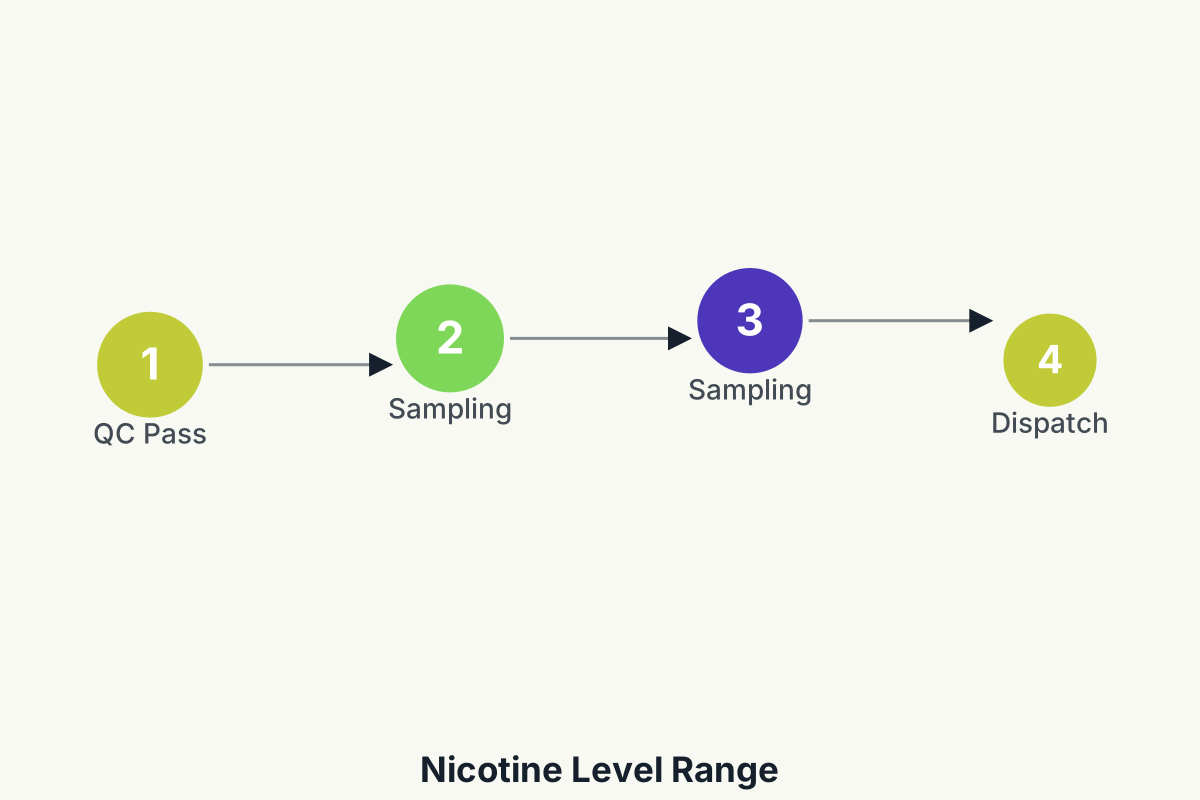
Inspection Before Dispatch
The defect rate that matters is the one your customer experiences, not the one the factory reports. Bridge that gap by inspecting the way a customer would open the box, not the way a line worker packs it.
- Check carton dimensions against your freight quote before confirming.
- Agree the tolerance band in writing before approving artwork.
- Model landed cost, not ex-works price, when comparing quotes.
- Keep sealed retained samples from every production batch.
- Plan the switch from air to sea freight before you need it.
Practical Checklist
- Plan the switch from air to sea freight before you need it.
- Ask how the factory measures puff count, then compare like with like.
- Agree the tolerance band in writing before approving artwork.
- Model landed cost, not ex-works price, when comparing quotes.
- Rotate stock by batch code rather than by delivery date.
- Write the complaint threshold into the order terms.
Frequently Asked Questions
What is the usual minimum order for nicotine level?
For a standard production run the minimum is normally one master carton per flavour, though mixed cartons can be arranged for a first order. If you are testing the line, ask about a sample pack first and treat the freight as part of your research budget.
How are price changes handled on repeat orders?
{K} pricing is reviewed against input costs and volume rather than adjusted casually. Any change is confirmed in writing before the next order is scheduled, with the reason stated so you can judge it yourself.
How do you handle a short shipment?
Cartons are counted and weighed before dispatch and the figures are shared with you. If something is short on arrival, the packing record and the carrier documentation are both available, which keeps the claim straightforward.
What if a batch does not match the sample?
Keep the retained samples from the approval stage. If a delivered batch measurably differs, we compare against the retained set and resolve it against the production record. This is why we insist on sealed retained units from every run.
What if I only need a small first order?
That is normal and sensible. A mixed carton lets you test nicotine level in your own market before committing to a production run, and the specification you approve at that stage carries through to larger orders unchanged.
Next Step
Whatever you decide, decide it against numbers you can check on arrival. That single discipline removes most of the risk from importing nicotine level.
Related Reading
- Nicotine Level Benchmarking Two Factories Side by Side — 2026 Edition
- Digital Marketing Playbook for Nicotine Level Sellers — Duty and Tax Worked Out
- Nicotine Level Electronic Data Interchange for Large Accounts — UK and Ireland
- Nicotine Level Carton Engineering and Freight Density — Seasonal Demand Peaks
- Nicotine Level Protecting Your Private Label Design — Online Sellers
- How to Brief a Factory on Nicotine Level — Three Price Tiers